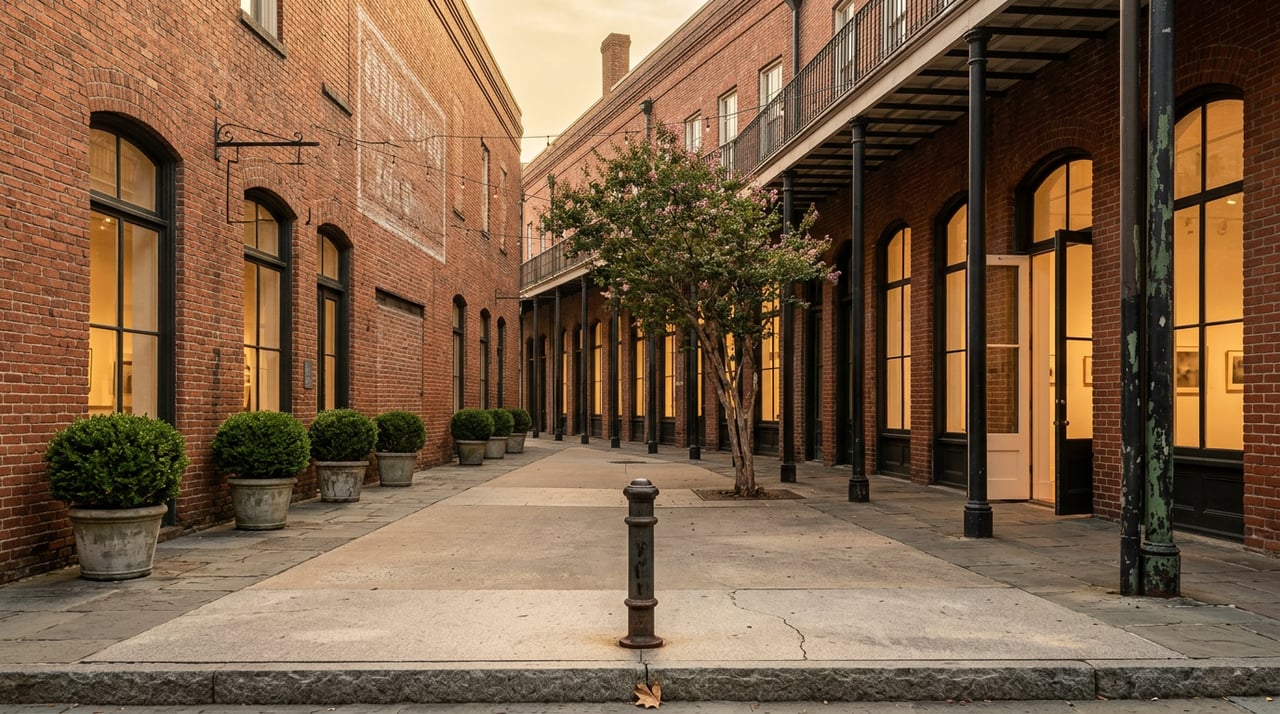
By five o'clock on August 1, the 300 block of Julia Street was already filling with people in white linen, moving between open gallery doors the way they have on the first Saturday of August for three decades. The crowd looked like it always does. What was different this year happened before anyone put on a single white shirt: for the 32nd annual White Linen Night, Arts District New Orleans brought in an outside producer for the first time, the nonprofit French Quarter Festivals, Inc.
That is not a footnote. It is the story of what your neighborhood's signature night is becoming, and it is worth understanding if you live close enough to hear the Main Stage from your porch.
The Handoff Nobody Announced Until This Summer
Arts District New Orleans, the organization that started White Linen Night in 1994 as a gallery stroll down Julia Street, has run the event itself for most of its life. This year, ADNO brought in French Quarter Festivals, Inc. as a production partner, the same nonprofit behind French Quarter Festival and Satchmo SummerFest, to handle what the organizations described as expanded production and cultural programming. The mission stayed put: a free, gallery-centered night on the 300 to 600 blocks of Julia Street, five to ten in the evening, no cover charge to walk the street.
What changed was scale. FQFI runs three of the city's largest annual festivals. Bringing that production apparatus to a single Saturday on Julia Street means more staging, more sponsor infrastructure, and a night that now gets planned alongside the rest of the city's festival calendar rather than as a standalone neighborhood event.
What a Bigger Producer Bought
Some of what showed up this year was familiar. Some of it wasn't.
Always part of White Linen Night | New for 2026 |
|---|---|
Free gallery stroll, 300-600 blocks of Julia Street | French Quarter Festivals, Inc. producing for the first time |
Wear white, no actual dress code | A ticketed Fidelity White Linen Experience at the Renaissance Arts Hotel, $135, with air conditioning and cocktails |
Galleries staying open late | A CAC After Dark party, $25, running 9 p.m. to midnight after the street event closes |
Main Stage music on the 300 block | Booked acts this year included Primus Roman, Robin Barnes & The Fiya Birds, and Irvin Mayfield |
The free street event is still free. But the money is now moving toward the tiers around it, a VIP lounge with a $135 ticket, a ticketed afterparty at the Contemporary Arts Center. That's what a bigger producer usually does: it doesn't touch the core offering so much as it builds paid experiences on either side of it.
The Same Weekend, A Different Festival Entirely
FQFI didn't just add production muscle to White Linen Night. It scheduled its own festival, Satchmo SummerFest, for the same weekend, August 1 and 2 at the New Orleans Jazz Museum on Esplanade Avenue. Satchmo, in its 26th year, honors Louis Armstrong with headliners like Kermit Ruffins' annual tribute set and Don Vappie and Jazz Creole, plus a Sunday jazz mass at St. Augustine Church followed by a second-line parade through Tremé and the French Quarter.
Two organizations that used to run separate events on separate calendars now have overlapping production on the same weekend, one in the Warehouse District and one in the French Quarter. If it felt like the whole downtown core was doing something cultural at once on the first weekend of August, that wasn't a coincidence. It was a plan.
The Cousin That Didn't Change
A week later, on August 8, the French Quarter held its own version of the night: Dirty Linen Night, spanning the 300 to 1100 blocks of Royal Street. It exists to promote the galleries and shops along Royal Street, not to compete with the Warehouse District event, and it has stayed the looser, homegrown version of the same idea, more territory, less structure, no outside producer stepping in to run it.
That's the useful contrast. Two events that share a name, a wardrobe color, and a shared origin as gallery-district art walks are now diverging. One picked up a festival producer, a VIP tier, and a ticketed afterparty. The other is still just galleries staying open and shops putting out wine. If you've walked both in the same August, you've already felt the difference without necessarily naming it.
What Still Belongs to the Galleries
The producer handoff covers one Saturday. It doesn't touch the monthly First Saturday Gallery Openings, which ADNO still runs on its own every first Saturday, starting at 6 p.m., down and around Julia Street, twelve months a year.
This year's White Linen Night exhibitions ran through those same galleries. The Arthur Roger Gallery hung Keith Duncan's paintings of second-line brass bands alongside Mitchell Gaudet's cast-glass sculptures, work that combines a flock of glass birds with a repurposed statue. LeMieux Galleries, Ferrara Showman, and Orleans Gallery each opened new group shows the same night. The Ogden Museum of Southern Art offered free admission, a cash bar, and music from DJ Ram, its usual White Linen Night arrangement, unaffected by who was running production down the street.
That's the part of the neighborhood's cultural life that doesn't change hands. Whoever books the Main Stage, the galleries are still the reason people come.
On Julia and Tchoupitoulas Right Now
The neighborhood's day-to-day kept moving through all of this. Patty's Burger Bar opened this year in the Warehouse District, bringing smash burgers, hand-spun malts, and a bourbon list running past 40 selections, including a Philly cheesesteak-style version layered with shaved rib-eye. It's the kind of casual addition that doesn't make festival headlines but changes what a Tuesday night on Tchoupitoulas actually looks like.
What to Watch Next August
None of this means White Linen Night is losing its character. The street event is still free, the galleries are still the draw, and the crowd still shows up in white whether or not they know who's running sound. But a nonprofit gallery association handing its biggest night to the same production company that runs the French Quarter's flagship festivals is a real shift in who shapes the Warehouse District's cultural calendar. Next August is worth watching for whether the free stroll stays the center of gravity, or whether more of the night moves behind ticketed doors.
If you live here, you already know the rhythm: First Saturdays year-round, one very big Saturday every August, and now a festival producer with a stake in how that big Saturday grows. That's not a small thing for a neighborhood that measures itself partly by how many people it can fit onto Julia Street without anyone paying for a ticket.
Neighborhood change shows up in plenty of places that never make an event calendar. If you're curious how the Warehouse District's shifting cultural footprint connects to what's happening on its blocks more broadly, I'm always glad to talk it through. Reach out to Tricia King any time.